Solar Billboard Lights Buying Guide | Eshine
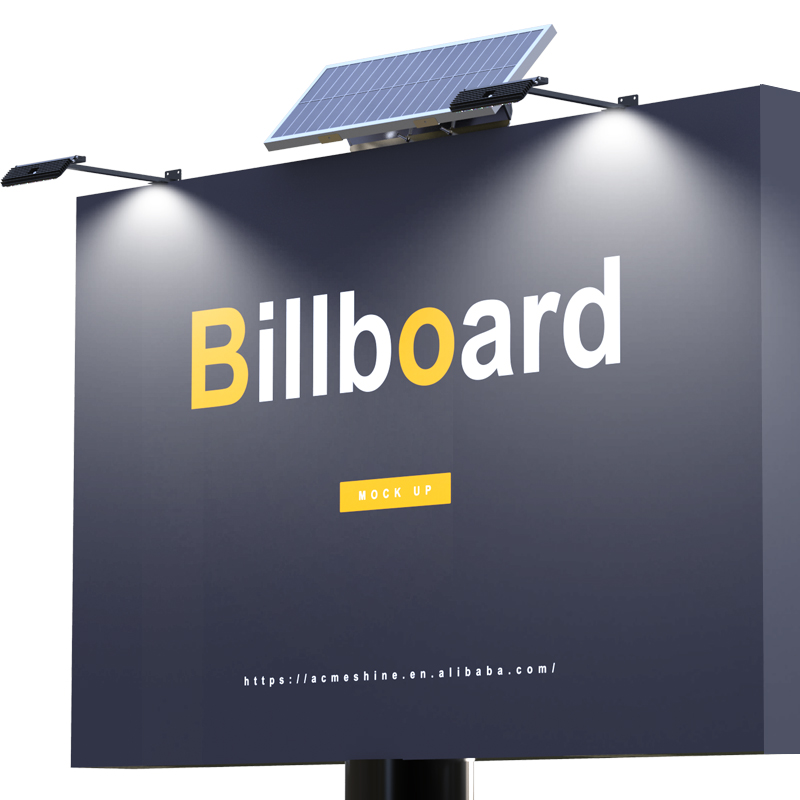
When an outdoor advertisement becomes difficult to read after dark, the problem is not always a lack of wattage. The light may be aimed poorly, the battery may run out too early, or the beam may leave the edges of the sign in shadow. Choosing solar billboard lights means matching an entire lighting system to the advertising surface and the installation site.
A low purchase price can also conceal expensive maintenance. Replacing a failed light above a roadside billboard may require a lift or crane, an installation crew and another visit to a remote location. For sign companies, contractors and billboard owners, dependable illumination and accessible components deserve as much attention as the initial quotation.
Why a 200W or 300W solar flood light label is not enough
A general-purpose solar flood light may work for a small sign if its verified output, beam and operating schedule meet the requirement. However, a 200W or 300W label alone does not prove suitability for a commercial billboard. Ask whether the number describes measured electrical power, an equivalent conventional lamp rating or a model designation.
Request actual power consumption, measured lumens and a lighting layout for your sign. Billboard lighting needs useful light on a vertical surface. A bright patch in the middle with dark corners can reduce readability even when the lamp looks impressive from the ground.
Define the sign width and height, the mounting distance, the number of illuminated faces and the required evening operating hours. A professional solar sign lighting proposal should explain the fixture quantity, aiming angles and expected coverage. Where available, request photometric files and calculated illuminance and uniformity at the sign face.
Select an MPPT controller as part of a properly sized system
An MPPT solar charge controller tracks the solar panel's maximum power point and converts the available power for battery charging. It can improve energy harvest compared with a suitable PWM alternative, but the benefit varies with panel voltage, temperature and operating conditions. Avoid treating a fixed percentage gain as universal.
For commercial solar advertising lights, specify an MPPT controller with compatible PV input limits, battery charging settings and load control. Confirm that the lighting schedule is programmable and remains set after a power interruption. Advertising often needs predictable evening illumination; motion-only operation may leave the sign dark when it should be visible.
MPPT cannot compensate for an undersized panel or battery. The supplier should calculate daily consumption and charging capacity for the site's difficult season, including shading, losses and the agreed autonomy period. A headline efficiency figure does not establish that the complete system can meet your schedule.
Check waterproof cables and every connection
An outdoor enclosure rating does not automatically cover the entire installed system. Waterproof solar sign lights also depend on cable glands, connectors, seals and workmanship.
Ask for outdoor cables with suitable UV resistance, conductor size and voltage-drop allowance. Connectors should have a documented ingress rating in their correctly assembled condition, a secure locking arrangement and strain relief. Cable routing should prevent water collecting at connection points and protect wiring from sharp edges or movement.
Confirm how technicians can disconnect and replace a damaged cable, controller or battery. A modular assembly can simplify maintenance, provided the replacement connectors and components remain available. Request photographs or drawings of the actual wiring arrangement before ordering.
Specify coastal materials beyond the housing name
For coastal solar billboard lighting, a properly selected aluminum alloy housing with suitable pretreatment and coating or anodizing is a strong option. Aluminum alone is not a guarantee against salt-related corrosion. Finish quality, damaged edges, trapped moisture and connections between different metals all matter.
Specify the fastener grade. Verified 304 stainless steel screws can suit many general outdoor installations, but they should not be assumed sufficient for salt-exposed coastal locations. For beaches, ports and islands, evaluate 316 stainless steel or a more resistant specification appropriate to the exposure. Even 316 is not maintenance-free in severe conditions.
Where stainless steel hardware meets aluminum, ask how the design controls galvanic corrosion, including suitable isolation and drainage. Salt-spray evidence is useful only when the test method, duration, assessed components and acceptance criteria are stated. A laboratory test duration should not be presented as a direct promise of years in service.
Compare maintenance cost before choosing the cheapest quotation
The purchase price is only one part of the cost of solar signboard lighting. Include installation, planned inspection, replacement components, access equipment, labor, travel and advertising downtime.
Consider a hypothetical example: a cheaper system saves US$150 at purchase. If it later needs one additional visit costing US$250 for access equipment, US$120 for labor and US$80 for parts, that visit totals US$450 and exceeds the initial saving by US$300. These figures illustrate the calculation only; they are not market prices or predicted failure rates.
Ask who pays for access equipment and labor under the warranty. A free replacement component does not necessarily cover the cost of reaching a high-mounted sign. Compare offers using the same lighting schedule, useful coverage, maintenance assumptions and evaluation period.
Questions to ask a solar billboard light supplier
Before approving a sample or bulk order, request answers to these questions:
- What measured power and light output does this exact configuration deliver?
- How many fixtures are needed to illuminate our sign evenly?
- What are the panel wattage and nominal battery energy in Wh?
- Which controller is supplied, and how is the nightly schedule programmed?
- What brightness schedule and weather assumptions support the autonomy claim?
- What are the cable, connector, housing and fastener specifications?
- Which parts can be replaced, and what does the warranty cover?
These questions help distinguish a documented commercial solar billboard lighting solution from a product selected mainly by its advertised wattage.
Frequently asked questions
Can I use a regular solar flood light for a billboard?
Yes, if verified coverage, output, energy capacity and durability meet the project requirements. Do not assume that a 200W or 300W label alone confirms those conditions.
Is an MPPT controller enough to guarantee all-night lighting?
No. Runtime also depends on battery capacity, daily solar charging, losses, shading and the programmed brightness level.
Are 304 stainless steel screws suitable for every coastal project?
No. Salt exposure may require 316 or another suitable specification, together with compatible materials, protective finishes and maintenance.
Request a solar billboard lighting proposal
Planning a new sign or replacing unreliable solar advertising lights? Send Eshine your project location, billboard dimensions, installation photographs, available mounting positions and required lighting hours. Ask for a proposal that identifies the configuration and maintenance provisions for your site.
Explore our commercial solar billboard and sign lights, or contact alice@eshinesolar.com with your project requirements.
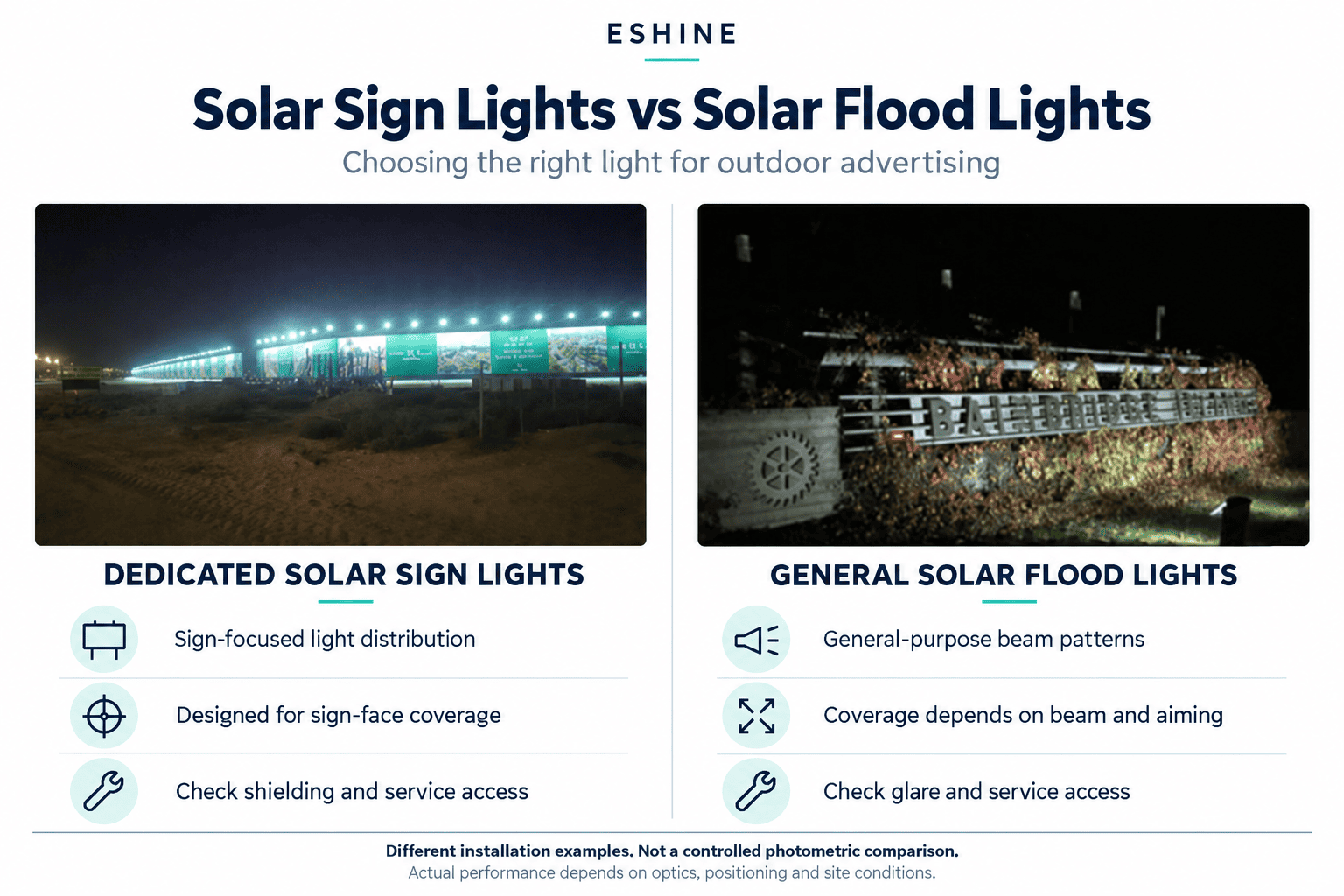
Dedicated Solar Sign Lights vs General Solar Flood Lights: Which Is Better for Outdoor Signs?
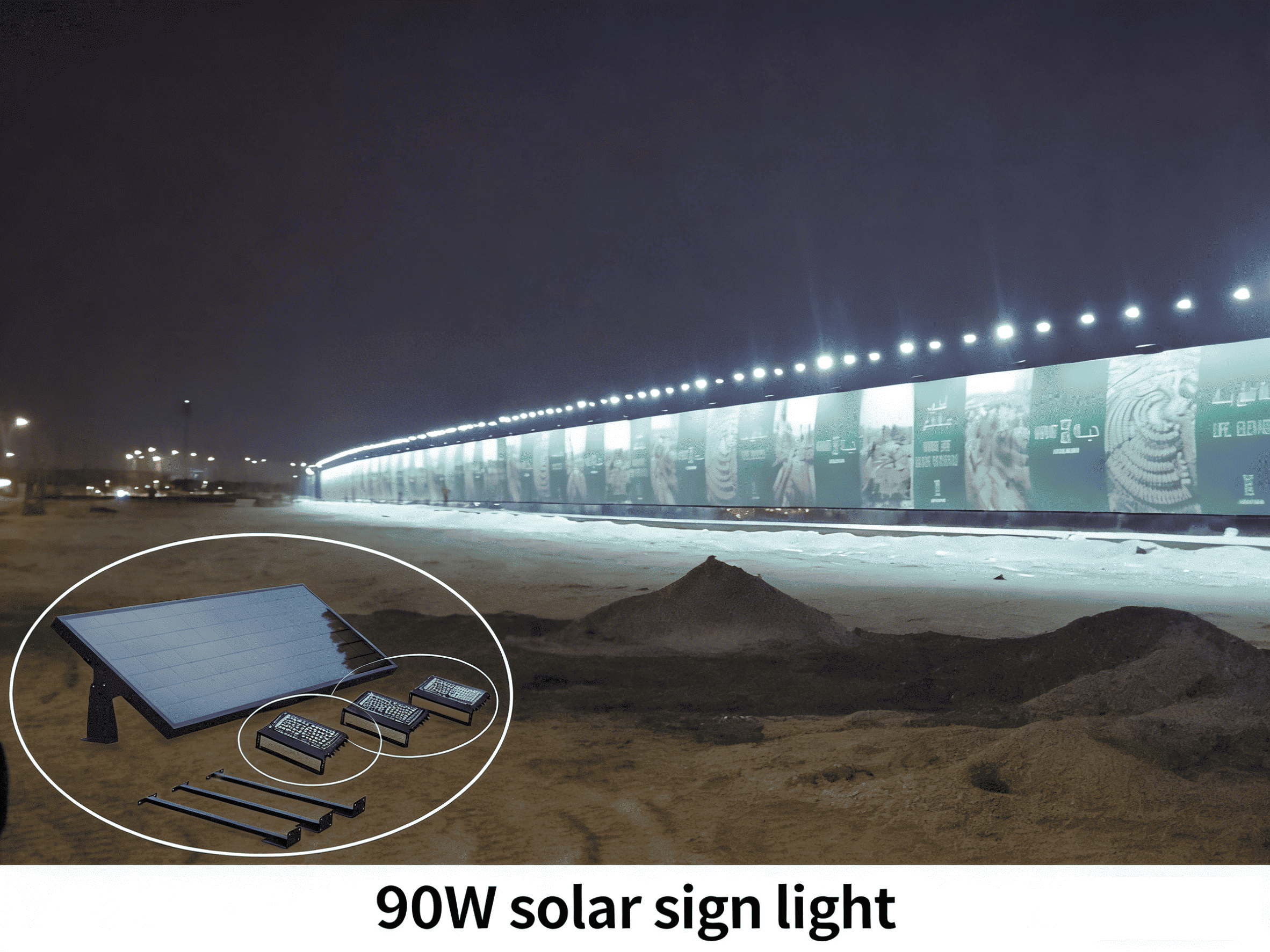
UAE Real Estate Construction Site Solar Billboard Lighting Project – 400 Sets Installed
Related Article