How to Choose Solar Parking Lot Lights for Commercial Projects
Choosing commercial solar parking lot lights starts with understanding the site—not simply comparing LED wattage. A successful installation needs to provide useful illumination where people walk and vehicles move, while storing enough solar energy to support the required lighting schedule.
For shopping centers, office buildings, industrial facilities, hotels, and other commercial properties, four factors deserve particular attention: site dimensions, pole layout, light distribution, and operating hours.
This guide explains how to evaluate these factors and when a dual-head solution, such as ESHINE’s ELS-D70 Series, may suit your project.
1. Start with the Parking Lot’s Dimensions and Daily Use
Before selecting a model, prepare a site plan showing the parking lot’s length, width, parking rows, access roads, and pedestrian routes.
Total area is a useful starting point, but two parking lots of the same size may require different lighting arrangements. A long, narrow parking area beside a warehouse differs significantly from an open square lot outside a shopping center.
Record the following information:
| Site information | Why it matters |
|---|---|
| Overall dimensions and shape | Establishes the area and geometry to be illuminated |
| Parking rows and driving aisles | Helps identify suitable pole locations and beam directions |
| Entrances, exits, and pedestrian crossings | Identifies areas requiring particular attention |
| Trees, buildings, and canopies | Reveals potential shadows and solar-panel shading |
| Existing poles and foundations | Helps assess whether existing infrastructure can be reused |
| Neighboring properties | Helps control unwanted light beyond the site boundary |
Consider how the property operates, too. An office parking lot that empties early in the evening has different lighting needs from a hotel or distribution center with overnight activity.
2. Plan Pole Locations Before Choosing Fixture Quantity
Effective solar parking lot lighting design coordinates pole positions, mounting height, fixture output, and beam distribution.
Avoid choosing the number of lights using a simple “square meters per fixture” estimate. This approach can overlook dark gaps, obstructed light, and excessive brightness near individual poles.
Common layout options include:
-
Perimeter poles: Useful where central parking spaces must remain clear. Fixtures should direct light into the lot while limiting spill toward neighboring properties.
-
Central-island poles: Worth considering where a pole can serve parking spaces or driving aisles on both sides.
-
Multiple rows of poles: Often necessary for wider sites where perimeter lighting alone cannot provide suitable coverage.
Higher poles can change the coverage pattern, but they do not automatically produce better lighting. Mounting height also affects ground-level illuminance, glare, maintenance access, and structural requirements.
Before confirming quantities, request a lighting calculation using the proposed fixture’s photometric file. Review the results against the project’s specified illumination and uniformity targets.
3. Evaluate Light Distribution, Not Just Wattage
Wattage describes electrical power consumption. It does not show how effectively a fixture illuminates parking spaces, vehicle lanes, or pedestrian routes.
Two luminaires with similar power ratings can produce very different results because of their optics, output, mounting height, and aiming.
A suitable design should evaluate:
-
Average illuminance: The overall light level across the evaluated area.
-
Minimum illuminance: Whether the darkest points receive sufficient light.
-
Uniformity: How evenly light is distributed.
-
Glare and spill light: Whether the installation creates discomfort or illuminates unwanted areas.
Uniformity deserves particular attention. A bright area beneath a pole does not compensate for poorly lit spaces between poles. Large contrasts can make people and vehicles harder to see in darker areas.
Ask the supplier for an IES or LDT photometric file and a layout calculation based on your actual site. A beam-angle figure alone cannot confirm whether a luminaire will meet the project’s requirements.
4. Match Lighting Hours to the Site’s Operating Schedule
For off grid parking lot lights, the lighting schedule directly affects battery and solar-panel sizing.
Clarify whether the project requires:
-
Full specified output throughout the night.
-
Higher output during business hours and reduced output after closing.
-
A maintained background level with motion-triggered increases.
-
Different schedules for different areas of the property.
For example, a commercial property might need higher output during evening customer activity, followed by a lower maintained level overnight. A facility operating around the clock may require a different approach.
Lighting controls should be considered during the design stage because they affect energy use and how the site functions after dark.
Do not accept a “dusk-to-dawn” claim without checking the brightness profile. Lighting for twelve hours at reduced output is different from maintaining full output for twelve hours.
5. Check Solar Availability and Battery Capacity Together
Reliable solar lighting depends on the relationship between daily energy consumption, solar charging, and usable battery capacity.
Ask the supplier to evaluate:
-
Project location and seasonal solar conditions.
-
Shading at the proposed panel positions.
-
The longest required nightly operating period.
-
Energy consumption under the agreed dimming schedule.
-
Usable battery capacity in watt-hours.
-
Required backup during poor-weather periods.
-
Temperature effects and system losses.
Battery amp-hours alone are not enough for comparison; voltage must also be considered. Likewise, a larger panel does not solve every problem if it is shaded or paired with insufficient battery storage.
For commercial procurement, request a documented energy balance based on the project location and operating profile.
6. When to Consider the ESHINE ELS-D70 Dual-Head Series
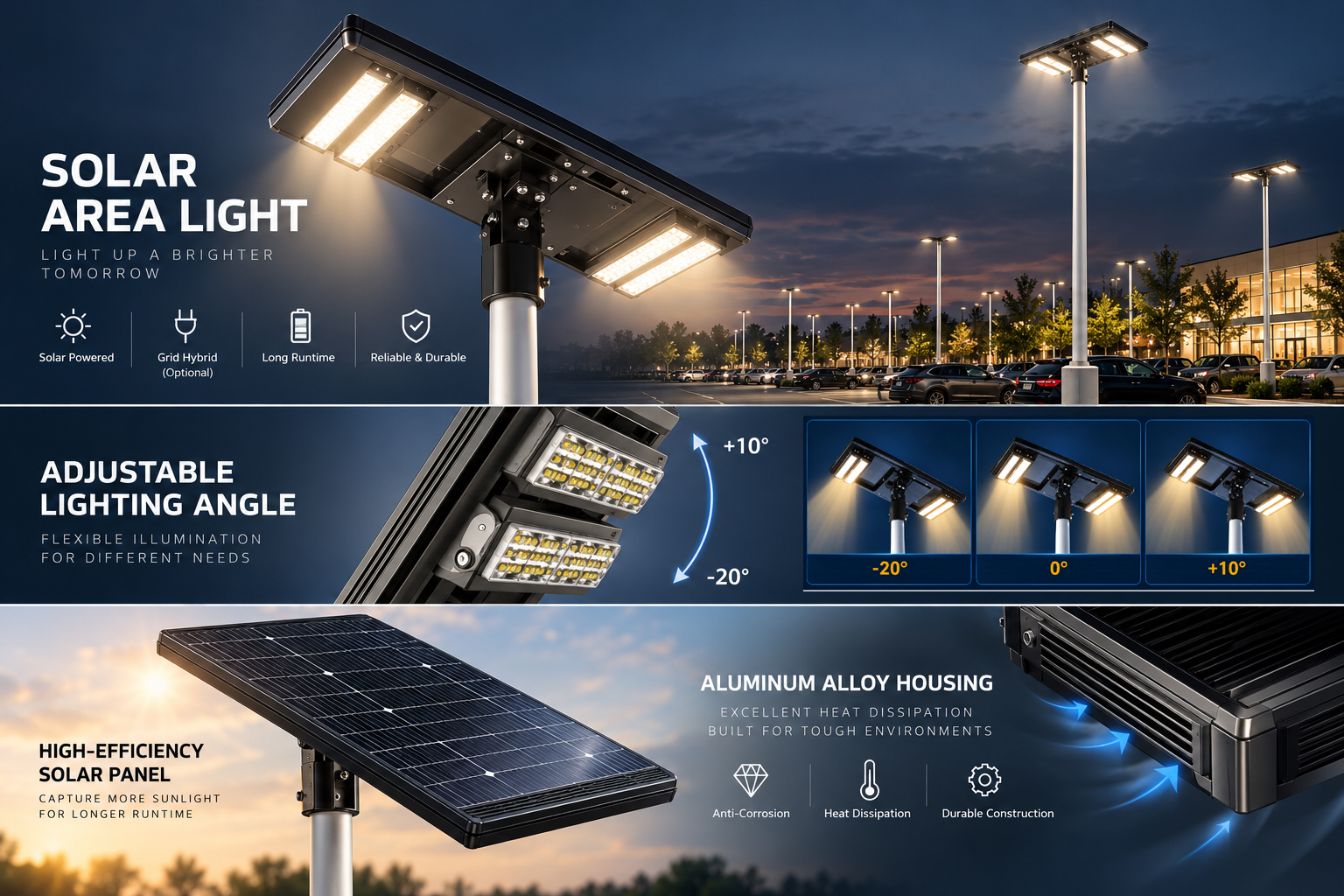
The ESHINE ELS-D70 dual-head solar street light series is an option to evaluate for commercial parking lots where a pole location needs to serve two sides of the surrounding area.
Potential applications include central parking islands, parking rows beside access lanes, and suitable positions within industrial or commercial sites.
A dual-head arrangement may help organize illumination around a shared pole position. However, it does not automatically halve the required pole quantity or guarantee twice the useful coverage. Results depend on the selected configuration, optics, mounting arrangement, and site geometry.
When considering the ELS-D70 Series, confirm:
-
The output and light distribution of the proposed configuration.
-
Whether the two-head arrangement suits the intended coverage.
-
The combined energy requirement of both heads.
-
Solar-panel and battery sizing for the lighting schedule.
-
Pole, foundation, and wind-load requirements.
The most effective approach is to compare the proposed ELS-D70 layout against the project’s lighting and energy requirements before finalizing the order.
7. Compare Total Project Cost
Purchase price is only one part of the investment.
Off-grid lighting can avoid grid-power cable runs and associated electrical trenching where these would otherwise be needed. However, the project still requires suitable foundations, installation work, and ongoing maintenance.
Compare quotations using the same illumination targets, operating schedule, and backup assumptions. Include pole and foundation costs, battery replacement, cleaning access, spare parts, and warranty coverage.
A lower-priced fixture offers limited value if the design requires additional poles or cannot maintain the agreed lighting performance.
Plan Your Commercial Parking Lot Lighting with ESHINE
Choosing the right commercial solar parking lot lights means matching the complete system to the site.
Share your parking lot dimensions, project location, proposed pole height, operating hours, and any lighting requirements with ESHINE. Our team can discuss suitable options, including the ELS-D70 dual-head series, and identify the configuration information needed for your project.
Contact ESHINE for ELS-D70 product details and a project-specific quotation.
What Determines Solar Street Light Prices? A Buyer’s Cost Breakdown
Solar Street Lights: Is Wattage Really the Most Important Factor? A Complete Guide
Related Article