What Determines Solar Street Light Prices? A Buyer’s Cost Breakdown
When comparing solar street light quotations, buyers often notice substantial price differences between products advertised with the same wattage. Two lights may both carry a “60W” label, yet have different solar panels, battery capacities, lighting performance, and operating schedules.
The reason is simple: a solar street light is a complete energy and lighting system. Its price reflects more than the LED power rating.
For distributors, contractors, and commercial project buyers, understanding these differences helps identify the right configuration and avoid unexpected maintenance costs.
1. Why Advertised Wattage Is Not Enough
Before comparing prices, ask what the advertised wattage actually represents: measured LED operating power, maximum power, or a marketing designation.
Wattage alone does not tell you how much useful light reaches the road or how long the system can maintain that output.
A meaningful comparison should include:
-
Measured luminaire output in lumens.
-
Complete luminaire efficacy in lumens per watt.
-
Light distribution and illumination at ground level.
-
Actual operating power and the nightly dimming schedule.
-
Solar panel capacity and battery energy storage.
Also distinguish LED chip efficacy from complete luminaire efficacy. Optical, electrical, and thermal losses mean that a chip-level figure should not be treated as the finished light’s performance.
The better buying question is: what lighting performance can this system deliver, for how many hours, under the project’s actual conditions?
2. Solar Panels: Capacity and Energy Collection
The solar panel must generate enough energy to support the required lighting schedule.
Panel-related cost differences come from rated output, conversion efficiency, construction, mounting hardware, and the space available for installation.
A larger panel can provide more charging capacity, but performance also depends on local sunlight, seasonal conditions, shading, orientation, and installation angle.
An inexpensive configuration sized around favorable summer conditions may struggle during the lowest-sunlight months.
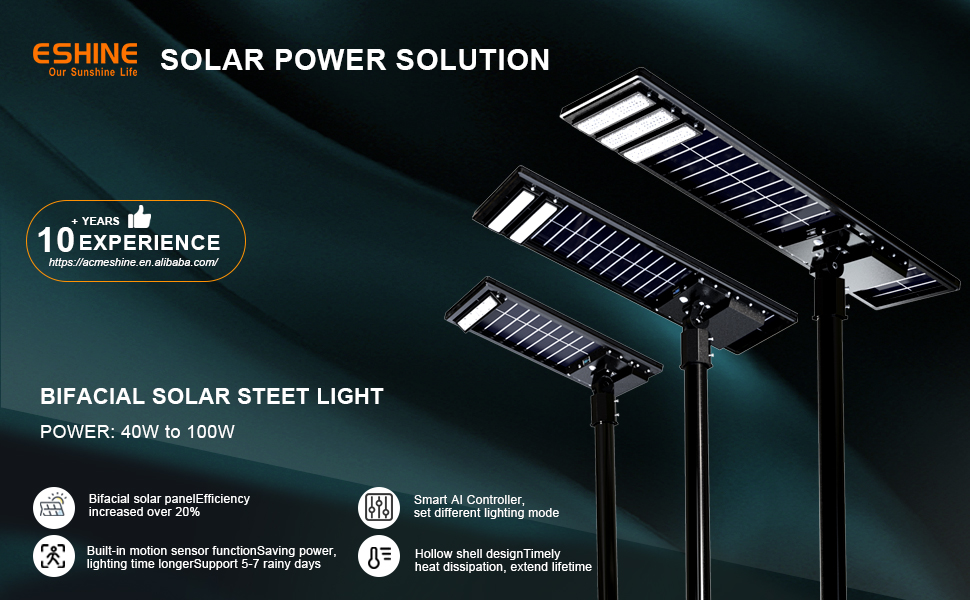
For bifacial panels, additional rear-side generation depends on reflected light and installation conditions. It should not be assumed to provide the same gain at every site.
What to ask: What is the panel’s rated capacity in Wp, and has the system been sized for the installation location and required operating schedule?
3. Batteries: Compare Watt-Hours, Not Just Amp-Hours
Battery capacity directly affects energy storage, operating time, and backup capability.
Comparing amp-hours alone can be misleading because voltage also matters:
Nominal battery energy (Wh) = Nominal voltage (V) × Capacity (Ah)
For example:
-
3.2V × 30Ah = 96Wh.
-
12.8V × 30Ah = 384Wh.
Both batteries are rated at 30Ah, but the second stores four times as much nominal energy.
Usable energy is lower than nominal energy and depends on discharge limits, temperature, battery condition, and system losses.
Battery price also reflects cell quality, protection electronics, pack construction, and replacement accessibility. If a supplier provides a cycle-life figure, ask about the test temperature, depth of discharge, and remaining-capacity threshold.
What to ask: What are the battery’s voltage, Ah, Wh, chemistry, usable capacity, and warranty terms?
4. Optics: Paying for Useful Light on the Road
A higher lumen rating does not automatically mean better road lighting.
The lens and optical design determine where the light goes. Poor distribution can create bright spots beneath the poles, dark areas between them, or unwanted light outside the target area.
A suitable optical design helps achieve the required illumination and uniformity for the road width, mounting height, and pole spacing.
For commercial projects, request an IES photometric file and a lighting calculation based on the actual layout. Check average and minimum illuminance, uniformity, and glare requirements where applicable.
What to ask: Does the proposed light distribution meet the project requirements at the planned mounting height and spacing?
5. Housing and Structure: Durability and Service Access
Housing and bracket design influence both purchase price and long-term reliability.
Relevant details include:
-
Housing material and protective finish.
-
Heat dissipation.
-
Gaskets, cable entries, and sealing.
-
Fastener materials and corrosion protection.
-
Bracket strength and adjustment range.
-
Access to replaceable batteries, controllers, and LED modules.
For coastal installations, assess the complete corrosion-protection system. An aluminum housing alone does not guarantee resistance to salt exposure.
Likewise, an IP rating describes ingress protection; it does not establish corrosion resistance or structural wind-load capability.
A serviceable design may cost more initially but reduce the work required when a component needs replacement.
6. Controls and Lighting Profiles: The Hidden Configuration Difference
Controllers manage charging, battery protection, and light output. Their specifications can materially affect system performance and price.
Compare charging technology, electrical ratings, temperature protection, programmable dimming, and sensor functions. MPPT capability can improve energy harvesting under suitable conditions, but the controller must be correctly matched to the panel and battery.
The lighting schedule is equally important.
Consider two hypothetical 40W systems:
| Operating schedule | Illustrative nightly LED energy demand |
|---|---|
| 40W for 12 hours | 480Wh |
| 40W for 4 hours, then 10W for 8 hours | 240Wh |
These figures exclude controller and other system losses. The systems carry the same maximum power rating, but their nightly energy demands differ substantially.
This is why “12 hours of lighting” or “three nights of backup” should always be accompanied by the operating profile and test conditions.
7. Warranty: Compare Coverage, Not Only Duration
A warranty’s value depends on what it covers and how claims are handled.
Before placing an order, confirm:
-
Whether the battery has the same warranty period as the complete light.
-
Which components and failure conditions are covered.
-
Whether replacement parts are readily available.
-
Who pays freight, removal, and reinstallation costs.
-
What documentation is required for a claim.
A longer warranty period does not necessarily mean lower ownership costs if important components or service expenses are excluded.
8. Compare the Complete Solar Street Light System Cost
The fixture quotation is only one part of the commercial solar street light cost.
A complete project budget may include the light, solar panel, battery, controller, pole, brackets, foundation, freight, installation equipment, commissioning, and future maintenance.
Check whether each quotation covers the same scope. An EXW fixture price cannot be directly compared with a delivered or installed system price.
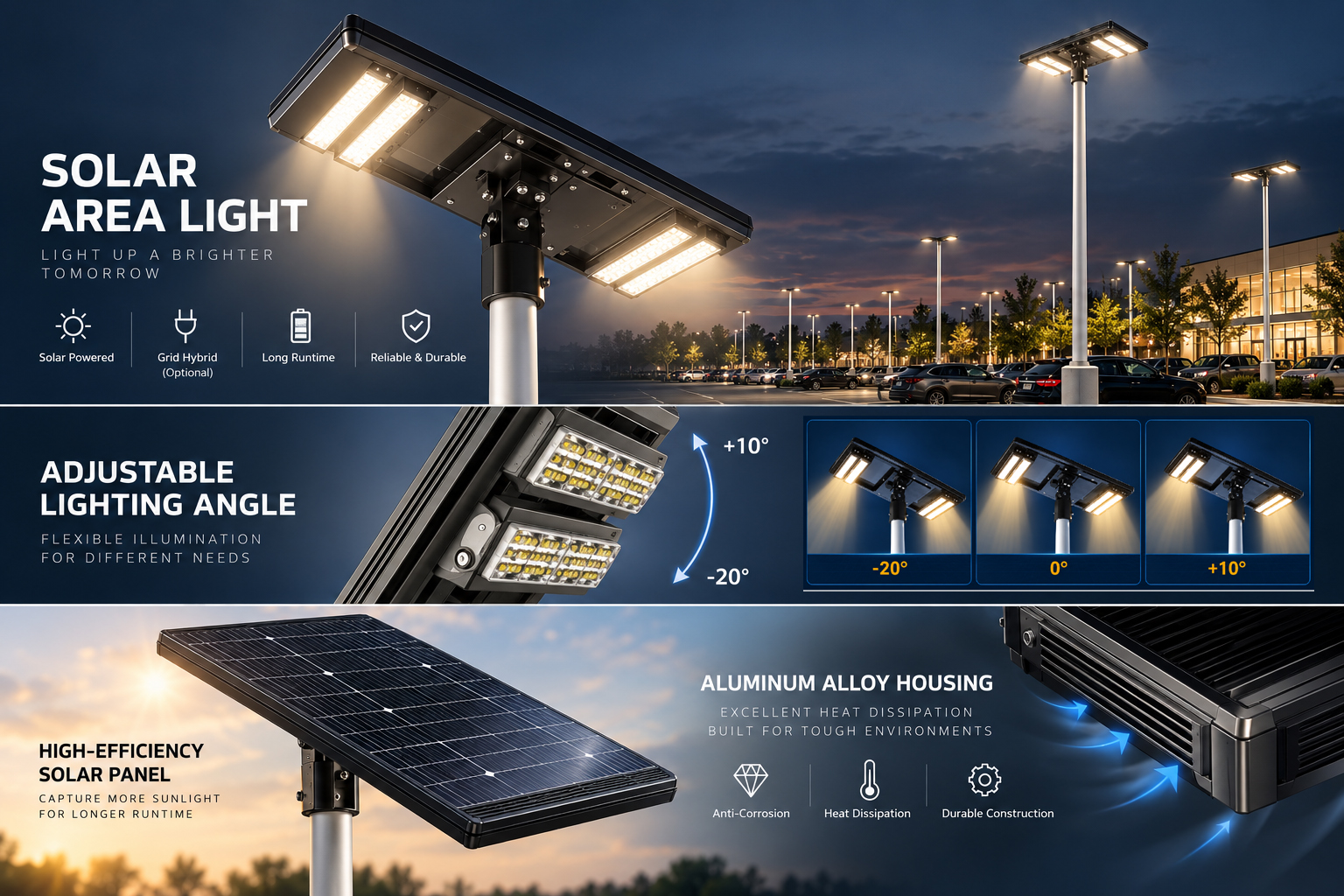
All-in-one designs may simplify installation, while split systems can offer more flexibility in panel positioning and component sizing. The appropriate configuration depends on the site and lighting requirements.
A Practical Checklist for Comparing Quotations
| Item | What buyers should compare |
|---|---|
| LED performance | Measured power, complete luminaire lumens, and efficacy |
| Solar panel | Rated Wp, construction, orientation, and seasonal sizing |
| Battery | Chemistry, voltage, Ah, Wh, and usable energy |
| Optics | IES file, beam distribution, and project lighting calculation |
| Operating schedule | Full-output hours, dimming levels, and sensor behavior |
| Backup capability | Defined operating profile and calculation conditions |
| Structure | Housing, corrosion protection, brackets, and service access |
| Warranty | Component coverage, exclusions, and replacement process |
| Quotation scope | Included equipment, trade terms, freight, and installation |
Choose the Configuration That Fits Your Project
The lowest solar street light price is not always the lowest lifetime cost. Equally, the most expensive configuration is not automatically the best choice.
The goal is to select a system that meets the required lighting level, nightly schedule, local solar conditions, and maintenance expectations.
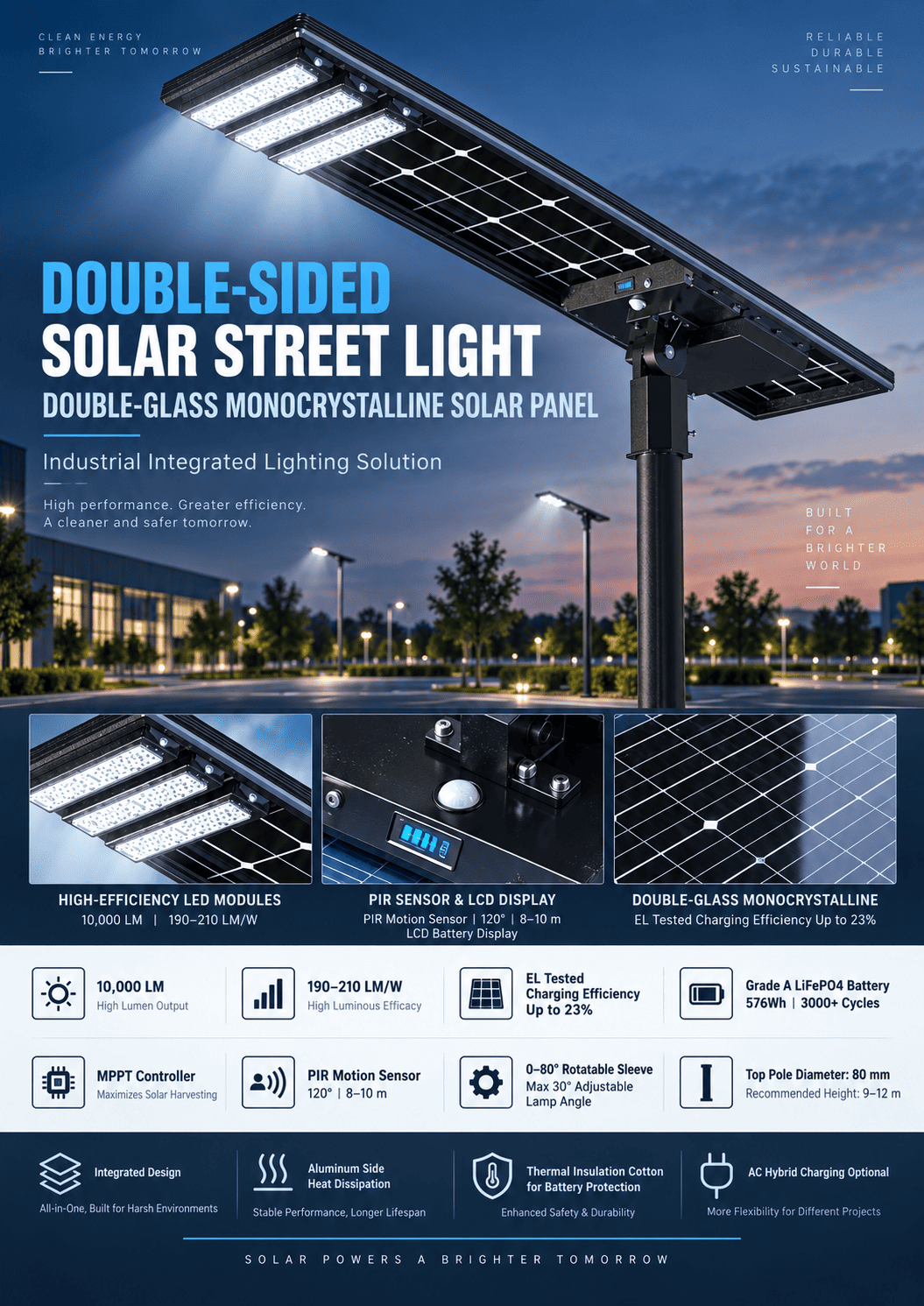
Shenzhen Eshine Technology Limited offers solar street lighting options for roads, parking lots, residential areas, and commercial sites, including all-in-one, split-type, dual-head, and bifacial configurations.
Planning a project? Share your installation location, road or site dimensions, pole height, spacing, required operating hours, and backup expectations. Our team can review your requirements and recommend a suitable configuration with a clear quotation.
How to Choose Solar Parking Lot Lights for Commercial Projects
Related Article